Contact us today at (718) 779-2134 to see how we can help you!
NYC Marshal Services in Jackson Heights, NY
Jackson Heights Landlords and Creditors Finally Have Real Enforcement Behind Them
Hear from Our Customers

Income Execution and Eviction Marshal Queens NY
When you’re managing a pre-war brick building in the Jackson Heights Historic District or running a business on Roosevelt Avenue, an unpaid judgment isn’t just frustrating — it’s a real financial drain that compounds every month. A one-bedroom in Jackson Heights runs close to $2,000 a month. A two-bedroom can push $2,900. Every week a non-paying tenant stays, or a debtor ignores a court order, that money doesn’t come back on its own.
What changes when you engage a court-appointed NYC Marshal is straightforward: the enforcement actually moves. Income execution puts a legal mechanism in place to garnish wages directly from the debtor’s employer. Property execution gives you the ability to pursue assets. And when a Warrant of Eviction has been issued by Queens Housing Court, we execute it — professionally, by the book, and without creating additional problems for you in the process.
Jackson Heights has one of the highest renter concentrations in all of Queens — about 63% of households here are renters. That means landlords in this neighborhood deal with tenancy issues at a scale and frequency that most individual homeowners never face. Having a marshal who understands the density of this housing stock, the procedural requirements under New York’s 2024 Good Cause Eviction law, and the specific dynamics of Queens enforcement isn’t a luxury. It’s what makes the difference between a judgment that sits on paper and one that actually gets satisfied.
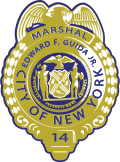
NYC Marshal Badge 14 Serving Queens NY
Edward F. Guida Jr., Badge #14, has been operating in Queens since 1988, when Edward Guida Sr. founded the office and spent 25 years building a reputation for accurate, professional civil enforcement across all five boroughs. Edward Jr. was brought into the practice in 2007, managed the office through a transition after his father’s passing, and was formally appointed NYC Marshal — Badge #14 — in 2016. The staff who worked under his father are still in the office today.
We’re based in Corona, which sits directly adjacent to Jackson Heights and falls within the same Queens Community District 3. That proximity means we know Queens Housing Court, understand the physical conditions of Jackson Heights’s dense apartment buildings, and have been navigating the borough’s enforcement landscape long before the current wave of post-pandemic eviction filings. We’ve handled cases in Jackson Heights continuously for over three decades.
Edward F. Guida Jr., Badge #14 Marshal Services is appointed by the Mayor of New York City, regulated by the NYC Department of Investigation, and carries a $100,000 public official’s bond. That’s not a marketing credential — it’s a legal requirement that separates a court-appointed marshal from any private collection agency operating in this space.

NYC Marshal Eviction Process Jackson Heights Queens
The process starts with you providing the necessary court documents — whether that’s a judgment from Queens Civil Court or Supreme Court, a Warrant of Eviction issued by Queens Housing Court, or a small claims judgment you’ve been sitting on. We review what you have, confirm what enforcement avenue makes the most sense, and get to work.
For income execution, the first step is serving the debtor directly — typically by mail — giving them 20 days to voluntarily make arrangements. If they don’t respond, we serve the execution on their employer on day 21, and the employer begins withholding a portion of the debtor’s wages each pay period. In a neighborhood like Jackson Heights, where a significant portion of the workforce is employed in service-sector jobs — food service, retail, transportation, and airport-adjacent industries near LaGuardia — identifying and properly serving the right employer matters. Our emphasis on accuracy and up-to-date procedures is directly relevant here, because a procedural error at this stage can delay or invalidate the garnishment.
For evictions, we serve the required notice to the tenant and schedule execution of the Warrant of Eviction. Under a 2024 state law, marshals are also required to post eviction notices to the state court website within 24 hours of service — a compliance requirement that we handle as a matter of standard procedure. Throughout all of this, every action is conducted with the neutrality and professionalism that protects you from blowback, complaints, or additional legal exposure.

Ready to get started?
Judgment Collection and Eviction Services Jackson Heights NY
Edward F. Guida Jr., Badge #14 Marshal Services handles the full range of civil enforcement that judgment creditors and landlords in Jackson Heights actually need. That includes income execution for wage garnishment, property execution for seizure of cash or personal property, landlord and tenant services for executing Warrants of Eviction or legal possession across all five boroughs, Supreme and Civil Court judgment collection, and small claims enforcement.
That last one is worth noting specifically. A lot of small business owners on 74th Street or along Roosevelt Avenue who won in small claims court assume there’s nothing left to do if the debtor won’t pay voluntarily. There is — we can enforce a small claims judgment by income execution or property execution, and you don’t need an attorney to initiate that process.
For landlords managing buildings in the Jackson Heights Historic District or the denser apartment corridors near Broadway and 37th Avenue, the Good Cause Eviction law signed in April 2024 has raised the procedural bar for market-rate tenancies. Notices must be served correctly, timelines must be met, and the execution of the warrant itself must be done without errors that give a tenant grounds to challenge the process. We use current technology and procedures across every step — not because it’s a selling point, but because in this regulatory environment, precision is what keeps the enforcement valid.

What does a NYC Marshal actually do that a collection agency can't?
A private collection agency can call, send letters, and report to credit bureaus. What they cannot do is execute a court order. Only a court-appointed officer — a NYC Marshal or sheriff — has the legal authority to garnish wages through an income execution, seize property under a property execution, or physically carry out an eviction under a Warrant of Eviction.
When you’ve obtained a judgment from Queens Civil Court or Queens Housing Court, the court doesn’t collect for you. You need someone with the legal authority to enforce it. Edward F. Guida Jr., Badge #14, holds that authority as an appointed marshal regulated by the NYC Department of Investigation. No collection agency operating in Jackson Heights or anywhere else in the five boroughs can say the same — and the difference matters the moment you need something actually done.
How does income execution work if my debtor works in Jackson Heights or near LaGuardia?
Income execution is a two-stage process. First, we serve the execution on the debtor — usually by mail — and give them 20 days to voluntarily contact our office and arrange payment. If they don’t, we serve the execution directly on the employer on day 21, and the employer is legally required to begin withholding a portion of the debtor’s wages each pay period and remit those funds to us.
In Jackson Heights, a large share of the workforce is employed in service-sector roles — food service, retail, ground transportation, and jobs connected to LaGuardia Airport just to the north. These are wage-earning positions that are subject to income execution. The garnishment is capped at 10% of the debtor’s gross wages per pay period, and the debtor’s net wages must exceed a minimum threshold to be eligible. The key variable is identifying and correctly serving the right employer — which is why accuracy in this step is critical. We handle that process with the precision that prevents errors from setting the timeline back.
Do I need an attorney to hire a NYC Marshal for a small claims judgment in Queens?
No. If you won a judgment in Queens small claims court and the debtor hasn’t paid voluntarily, you can engage us directly to enforce it — you don’t need to hire an attorney first. We can pursue enforcement through income execution or property execution, depending on what assets or income the debtor has available.
This is something a lot of small business owners in Jackson Heights don’t realize. If you extended credit to a customer or vendor, took them to small claims court, won, and still haven’t seen a dollar — the process isn’t over. You’ll need to provide the judgment documents and any information you have about the debtor’s employer or assets, and we walk you through what’s needed. The enforcement costs associated with the process are governed by New York State statute and are typically added to what the debtor owes, so your out-of-pocket advance to start the process is relatively modest.
How does the 2024 Good Cause Eviction law affect landlords in Jackson Heights trying to evict a tenant?
The Good Cause Eviction law, signed in April 2024, extended new protections to tenants in unregulated market-rate apartments — which make up a significant portion of Jackson Heights’s rental stock. Under this law, landlords must now provide specific notice periods before non-renewal (ranging from 30 to 90 days depending on tenancy length), and tenants have new grounds to challenge evictions that don’t follow the required process.
What this means practically is that by the time a landlord has obtained a Warrant of Eviction from Queens Housing Court, every prior step needs to have been done correctly — and the execution of that warrant needs to be handled without procedural errors that give the tenant additional grounds to challenge it. A separate 2024 state law also requires marshals to post eviction notices to the state court website within 24 hours of service. We handle that compliance requirement as standard procedure. For landlords managing buildings in the Jackson Heights Historic District or along the Roosevelt Avenue corridor, working with a marshal who is current on these requirements isn’t optional — it’s what keeps the eviction valid.
What's the difference between legal possession and eviction in New York City?
Both are carried out by a NYC Marshal after a court order is issued, but they apply to different situations. An eviction — sometimes called a warrant of eviction — is the removal of a tenant who remains in possession after the court has ruled against them in a holdover or non-payment proceeding. Legal possession is the process by which a landlord regains access to a unit after a tenant has already vacated but may have left belongings behind, or where access is disputed.
In practical terms, the distinction matters because the paperwork, notice requirements, and process steps differ between the two. Queens Housing Court handles both types of proceedings for Jackson Heights properties, and we execute whichever order the court issues. If you’re not sure which one applies to your situation, that’s a question worth clarifying before you file — the type of proceeding you bring determines the type of order the court can issue, which in turn determines what we can do.
How long does it typically take to get a marshal to execute a Warrant of Eviction in Jackson Heights?
Once you have a Warrant of Eviction issued by Queens Housing Court, we are required to serve the tenant with a minimum 14-day notice before executing the warrant. That notice period is set by New York State law and applies uniformly — there’s no way to shorten it. After the notice period passes, we schedule the execution, which takes place during standard enforcement hours.
A few local factors are worth knowing. The NYC Department of Investigation has the authority to suspend eviction executions during severe winter weather — as recently happened in January 2026 — which can push scheduled evictions back by a day or more. Summer, particularly July and August, is historically the peak period for eviction filings citywide, which can affect scheduling availability. Working with an office that has efficient scheduling systems and clear communication about timelines — rather than one that leaves you waiting without updates — makes a real difference when you’re counting days of lost rent. Our Corona location, directly adjacent to Jackson Heights, also means there’s no significant travel delay when it comes time to execute.
Contact Us Today
Call us at (718) 779-2134 or email us at guidajr@nycmarshal14.com to see how we can help.