Contact us today at (718) 779-2134 to see how we can help you!
NYC Marshal Services in Flushing, NY
Flushing's Commercial Density Demands More Than a Collection Letter

Hear from Our Customers

Eviction Marshal and Judgment Enforcement, Queens
Winning a judgment is one thing. Getting paid is another. The court issues the ruling — but it doesn’t collect for you. That’s where a court-appointed NYC Marshal comes in, and the difference between having one and not having one is the difference between a judgment that sits on paper and money that actually comes back to you.
For landlords in Flushing — whether you own a storefront on Main Street, a two-family home in Murray Hill, or a commercial unit near Roosevelt Avenue — the enforcement process has gotten more layered since 2024. The Good Cause Eviction law added procedural requirements that, if mishandled, can expose you to legal liability. Having a marshal who executes warrants precisely and in compliance with current regulations isn’t a luxury. It’s how you protect yourself.
For business owners and creditors in what is genuinely the fourth-largest central business district in New York City, the stakes are just as real. Flushing’s commercial ecosystem runs on credit — suppliers, service providers, landlords, and contractors extending trust to one another every day. When that trust breaks down and ends up in civil court, you need enforcement that moves fast, because a debtor who’s still operating a business has every opportunity to move assets while you wait. A court-appointed marshal can garnish wages, seize property, and execute warrants. A collection agency cannot.
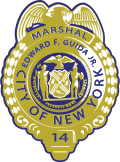
NYC Marshal Badge #14 Serving Queens
We’ve been part of New York City’s civil enforcement landscape since 1988, when Edward F. Guida Sr. founded the office. Edward Jr. came into the work in 2007, took over the office after his father’s passing, and was formally appointed Marshal, City of New York in 2016. The office manager and staff who worked under Edward Sr. still work here today. That’s not a talking point — it’s the kind of continuity that means fewer errors, faster processing, and a team that has genuinely seen every variation of what can happen in this process.
We’re based in Corona, Queens — directly adjacent to Flushing, with Flushing Meadows–Corona Park sitting between the two neighborhoods. That proximity isn’t incidental. It means familiarity with Queens Housing Court at Sutphin Boulevard, familiarity with the geography of the neighborhoods we work in, and a team that operates in this part of Queens regularly. Our appointment by the Mayor of New York City, Badge #14, is verifiable on NYC.gov — we are an officially appointed office, not a collection agency operating in a gray area.

Income Execution and Eviction Process, Flushing NY
The starting point is always a court order. We cannot initiate an eviction or garnish wages on your behalf without one — that’s the law, and it’s also your protection that the process is legitimate. For landlords, that means a Warrant of Eviction issued by Queens Housing Court. For judgment creditors, it means a civil court judgment from NYC Civil Court or Supreme Court. Once you have that document, the enforcement process can begin.
For income execution — wage garnishment — the process works in two stages. First, we serve the income execution on the debtor directly, giving them 20 days to voluntarily contact our office and arrange payment. If they don’t respond within that window, we serve the execution on the debtor’s employer. From that point, the employer withholds up to 10% of the debtor’s gross wages each pay period and remits those funds to us, and we pass them on to you. The debtor’s employer can be anywhere in the five boroughs — if they work in Manhattan, Brooklyn, or anywhere else in the city, we can still serve them.
For evictions, we execute the Warrant of Eviction issued by Queens Housing Court, handle the required notice procedures — including the 2024 state requirement to post notices to the court website within 24 hours of service — and conduct the enforcement professionally and without escalation. Every step is handled in a way that protects your legal position and keeps the process moving.

Ready to get started?
NYC Marshal Services for Flushing Creditors and Landlords
We handle the full range of civil enforcement that creditors and landlords in Flushing need. That includes Supreme and Civil Court judgment collection, property execution, income execution, landlord and tenant services — both legal possession and full eviction — and small claims enforcement. All of it, across all five boroughs.
The small claims piece is worth calling out specifically, because it’s the one most people don’t know about. Flushing’s commercial environment generates a steady volume of small-dollar disputes — unpaid invoices between a supplier and a restaurant, a service provider who never got paid, a contractor left holding a balance. Many of those end up in small claims court, and many winners walk away thinking there’s nothing more they can do. There is. We are authorized to enforce small claims judgments by property execution or income execution across all five boroughs. If you won and they still haven’t paid, that judgment doesn’t have to sit there.
For property execution — the seizure of cash or personal property to satisfy a judgment — we conduct ourselves in a neutral, unbiased, and professional manner with all parties involved. In a tight-knit commercial community like Downtown Flushing, where business relationships overlap and reputations carry weight, that matters. Enforcement that’s handled professionally protects your standing in the community, not just your judgment balance.

How do I hire a NYC Marshal to enforce a judgment in Flushing?
The process starts with your court documents. To engage us for income execution or property execution, you’ll need the original judgment from NYC Civil Court or Supreme Court, along with information about the debtor — where they work, what assets they have, or where they bank. The more information you can provide upfront, the faster the enforcement can move. You contact our office directly, provide the necessary documentation, and we handle the rest — serving notices, engaging employers, and executing the judgment through the appropriate legal channel.
For Flushing creditors, it’s worth knowing that the debtor doesn’t have to live or work in Flushing for enforcement to proceed. If they’ve moved to another borough or their employer is in Manhattan, we’re authorized to enforce across all five boroughs and can still reach them. You don’t need to locate a different marshal for each borough — our office handles the full city.
What's the difference between a NYC Marshal and a collection agency in Queens?
A private collection agency can send letters, make calls, and report to credit bureaus. That’s roughly where their authority ends. A court-appointed NYC Marshal is an entirely different category. We are appointed by the Mayor of New York City and are authorized by law to execute Warrants of Eviction, conduct income executions that compel employers to withhold wages, and seize property under court order. None of those actions are available to a collection agency — they require a court-appointed enforcement officer.
This distinction matters especially in Flushing, where many creditors have already tried the collection route and hit a wall. If you have a civil court judgment and the debtor still isn’t paying, a collection agency can’t change that. We can. The legal authority behind a court-appointed marshal is what makes enforcement real rather than just persistent.
As a Flushing landlord, what do I need before calling a marshal for an eviction?
You need a Warrant of Eviction issued by Queens Housing Court — located at 89-17 Sutphin Boulevard in Jamaica. We cannot initiate an eviction without it. The court issues the warrant after the landlord wins their case; our role is to execute it, not to start the process. If you’ve won in housing court and have the warrant in hand, that’s when you call us.
Since the Good Cause Eviction law was signed in April 2024, the procedural stakes for landlords have increased. The law applies citywide, including Flushing, and adds layers to the eviction process — particularly for unregulated tenants. There’s also the 2024 state requirement that marshals post eviction notices to the court’s online system within 24 hours of service. Working with a marshal who uses current technology and follows these requirements precisely is important, because a procedural error doesn’t just slow things down — it can create legal exposure for the landlord.
Can a NYC Marshal garnish wages from an employer outside of Flushing or Queens?
Yes. An income execution can be served on an employer anywhere within the five boroughs of New York City. If the debtor works in Manhattan, the Bronx, Brooklyn, or Staten Island, we can serve the income execution on that employer directly. The debtor’s employer is required by law to withhold up to 10% of gross wages per pay period and remit those funds to us, and we then pass them to you as the creditor.
This is relevant for Flushing creditors because the neighborhood draws workers and business owners from across Queens and beyond — many debtors who owe money to Flushing-based businesses don’t live or work in Flushing. The 7 train alone connects Flushing-Main Street to Midtown Manhattan, and plenty of debtors commute out of the neighborhood entirely. A marshal with full five-borough authority can follow that connection wherever it leads.
How much does it cost to hire a NYC Marshal for judgment enforcement?
Marshal fees in New York City are set by state statute — they’re not negotiated or arbitrarily priced by our office. The fee structure is governed by New York law, and the specific amounts for each action are fixed. There are no published price packages or tiers, because the fees aren’t ours to set.
What’s important to understand is that enforcement costs are typically added to what the debtor owes — meaning the creditor often recoups those costs as part of the collection. For a Flushing business owner or landlord who is owed several thousand dollars, the statutory enforcement fees are a small fraction of the recovery. The more relevant question is usually not what it costs, but whether the judgment is collectible — and that depends on what assets or income the debtor has. The more information you can provide about the debtor’s employer or assets upfront, the more efficiently the enforcement can proceed.
I won in small claims court in Flushing but the other party never paid — now what?
Winning in small claims court doesn’t automatically put money in your pocket — the court issues the judgment, but collection is your responsibility. What many small claims winners in Flushing don’t realize is that a court-appointed marshal is authorized to enforce those judgments, just like any other civil court judgment. That means property execution — seizure of the debtor’s assets — or income execution — wage garnishment from their employer — are both available to you.
Flushing’s commercial environment generates a lot of small-dollar disputes that end up in small claims court: unpaid invoices, service fees that never got paid, deposits that weren’t returned. These cases are real money, even if the dollar amounts feel modest compared to a major civil judgment. If you have a small claims judgment and the other party has ignored it, contact our office with whatever information you have about the debtor — where they work, what business they run, what assets they have. That’s where the enforcement process starts, and it’s available to you regardless of the size of the judgment.
Contact Us Today
Call us at (718) 779-2134 or email us at guidajr@nycmarshal14.com to see how we can help.