Contact us today at (718) 779-2134 to see how we can help you!
NYC Marshal Services in Corona, NY
Corona's Highest Eviction Rate Needs a Marshal Who's Already Here

Hear from Our Customers

Queens Eviction Marshal and Judgment Enforcement
Winning a court judgment feels like the finish line. It isn’t. The court issues the order — it doesn’t collect the money, remove the tenant, or touch the debtor’s paycheck. That part requires a court-appointed NYC Marshal, and without one, a judgment is just paper.
For landlords in Corona, this matters more than almost anywhere else in the city. The NYU Furman Center documented ZIP code 11368 as having the highest eviction filing rate in all of New York City at the restart of housing courts after the pandemic moratorium — 2.94 filings per 100 private rental units. That reflects a neighborhood where most residents rent, where housing cost burden runs above 34% of household income, and where small individual landlords are managing these situations without the support of a property management company behind them.
For small business owners on Roosevelt Avenue or the surrounding commercial streets, the same reality applies. A Civil Court judgment or small claims ruling against a non-paying customer or vendor doesn’t move on its own. A private collection agency can send letters. Only a court-appointed marshal can garnish wages, seize property under court order, or physically execute a Warrant of Eviction.
That distinction is the difference between a judgment you hold and money you actually recover.
NYC Marshal Serving Corona, Queens
We’ve been operating out of 47-26 104th Street in Corona since 1988 — the same address, the same ZIP code, the same community. Edward F. Guida Sr. founded the office and served for 25 years. Edward F. Guida Jr. came into the field in 2007, managed the office through a transition after his father’s passing, and was formally appointed NYC Marshal in 2016.
The office manager and staff who worked under the founder continue under the son. That kind of continuity doesn’t happen by accident.
This is not a borough-level office that happens to cover Corona. It’s a Corona office. Queens Housing Court, where your warrant was issued, is the same court we’ve been working with for decades. When you call, you’re reaching someone who knows this neighborhood — not someone learning it on your case.
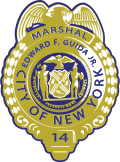
Badge #14 is a mayoral appointment, verifiable on NYC.gov, regulated by the NYC Department of Investigation, and backed by a $100,000 public official’s bond. That’s the accountability structure behind every action we take.

NYC Marshal Enforcement Process in Queens
The process starts with you providing the right documents. For an eviction, that means a Warrant of Eviction issued by Queens Housing Court — we cannot act without it, and no one can skip that step. For a judgment enforcement matter, you’ll need the judgment itself along with whatever asset information you have: employer name and address, known bank accounts, or property the debtor owns.
The more you can provide upfront, the faster things move.
For income executions — what most people call wage garnishment — we serve the debtor first, giving them 20 days to voluntarily arrange payment. If they don’t respond within that window, we serve the execution directly on the employer. The employer then withholds up to 10% of the debtor’s gross wages per pay period and remits those funds through us to you.
In a neighborhood like Corona, where a large portion of the workforce is in hourly and service-sector jobs, this is often the most direct path to recovery.
For evictions, once the Warrant of Eviction is in hand, we schedule and execute the removal. A 2024 state law now requires marshals to post eviction notices to the state court system online within 24 hours of service — we operate in full compliance with that requirement. Throughout the process, every action is handled professionally and neutrally, which matters when you’re a small landlord who still has other tenants in the building and a reputation to protect on the block.

Ready to get started?
Judgment Collection and Eviction Services in Corona, NY
We handle the full range of civil enforcement that Corona landlords and creditors need. That includes income execution (wage garnishment), property execution (seizure of cash or personal property to satisfy a judgment), landlord and tenant services including legal possession and eviction, Supreme and Civil Court judgment collection, and small claims enforcement.
All of it, across all five boroughs, from one office.
The small claims piece is worth calling out specifically, because a lot of people in Corona don’t realize it’s an option. If you won in small claims court — against a contractor who didn’t finish the job, a vendor who didn’t deliver, a tenant who owes back rent — and the other party simply isn’t paying, we can enforce that judgment by property execution or income execution.
You don’t need a Supreme Court case or a large dollar amount. The judgment you already have may be enough to start the process.
Fees for marshal services are set by New York State statute — they’re not arbitrary, and they’re not negotiable upward. More importantly, enforcement costs are typically added to what the debtor owes, which means you often recover those costs as part of the collection. We retain 5% poundage on amounts collected, which means the incentive is aligned: we earn more when you recover more.

How do I start the eviction process in Corona if I already have a court order?
If Queens Housing Court has already issued a Warrant of Eviction, you’re past the hardest part of the legal process — but you’re not done. The warrant authorizes the removal; it doesn’t execute it. You need to bring that warrant to a court-appointed NYC Marshal, who will schedule and carry out the physical eviction.
When you contact us, you’ll provide the warrant and any relevant case details. We’ll schedule the eviction during legal hours and handle the process from there. Under a 2024 state law, we’re also required to post the eviction notice to the state court system online within 24 hours of service.
If you’re a small landlord managing a building in Corona and you need this handled efficiently and without unnecessary friction, the fact that our office is already in your ZIP code makes a real logistical difference.
What is an income execution and how does wage garnishment actually work in Queens?
An income execution is a court-authorized order that allows a marshal to collect a portion of a debtor’s wages directly from their employer. It’s one of the most effective enforcement tools available when you know the debtor is employed but isn’t paying voluntarily.
Here’s how it works in practice: we first serve the income execution on the debtor, giving them 20 days to contact our office and arrange voluntary payment. If they don’t respond within that window, we serve the execution on the employer. From that point, the employer is legally required to withhold up to 10% of the debtor’s gross wages per pay period and remit those funds through us to you.
In Corona, where a large share of the workforce is in hourly service, food, and construction jobs, income execution is often a direct and reliable path to recovery — especially when property assets are limited. The debtor’s net wages must exceed 30 times the federal or state minimum wage to be subject to garnishment, so we’ll assess eligibility when you initiate the process.
Can a NYC Marshal enforce a small claims court judgment in Corona, NY?
Yes — and this is something a lot of people don’t know. If you won a judgment in small claims court and the other party isn’t paying, you are not on your own. A court-appointed NYC Marshal is authorized to enforce small claims judgments by property execution or income execution across all five boroughs, including Corona.
This matters particularly for small business owners in Corona — the restaurant owners, contractors, and service providers on Roosevelt Avenue and the surrounding streets who extend informal credit or work on contract. If a customer or vendor owes you money and you’ve already gone through small claims court, you don’t need to start over or hire an attorney for a larger case.
The judgment you have is the legal foundation. What you need next is a marshal to act on it. We handle small claims enforcement the same way we handle Civil and Supreme Court judgments — with the same legal authority and the same process.
What's the difference between a NYC Marshal and a private collection agency?
This is one of the most important distinctions to understand before you spend time or money on enforcement. A private collection agency can contact a debtor, send letters, report to credit bureaus, and negotiate. What it cannot do is execute a court order.
It has no legal authority to garnish wages under a court-issued income execution, seize property under a property execution, or physically remove a tenant under a Warrant of Eviction.
A court-appointed NYC Marshal — like Edward F. Guida Jr., Badge #14 — has that authority. It comes from a mayoral appointment, regulated by the NYC Department of Investigation, and backed by a $100,000 public official’s bond. When a debtor ignores a collection agency, the agency’s options are limited. When a debtor ignores a marshal’s income execution, we go to the employer directly.
When a tenant won’t leave after a court order, we execute the warrant. The legal weight behind a marshal’s actions is categorically different from anything a private agency can do — and for creditors and landlords in Corona dealing with non-responsive debtors, that difference is the whole ballgame.
What if the debtor in my Corona case has no job or obvious assets to go after?
Income execution is not the only tool available. If a debtor is unemployed or you don’t have employer information, property execution is another avenue — we can seize cash or personal property belonging to the debtor to satisfy the judgment. Bank accounts can also be targeted through a bank execution, which restrains funds held at financial institutions.
The effectiveness of any enforcement action depends partly on what assets you can identify. The more information you bring to us — employer name and address, known bank accounts, vehicles, business interests — the more options we have to pursue recovery.
In Corona, where many residents work in cash-heavy or informal employment arrangements, this can take some additional legwork on your end. But it doesn’t mean the judgment is uncollectable. It means you need to think through what you know about the debtor’s financial life and bring that information to the conversation. We can help you understand which enforcement avenue makes the most sense given what you have.
Why does it matter that our marshal's office is physically located in Corona, NY?
It matters for practical reasons more than sentimental ones. Corona is one of the most densely populated neighborhoods in the United States — over 85,000 people per square mile, with a housing court pipeline that documented the highest eviction filing rate in New York City. When you’re dealing with a time-sensitive enforcement matter in a neighborhood this active, having a marshal whose office is at 47-26 104th Street — in the same ZIP code, steps from the 7 train corridor, one block from 108th Street — is a real operational advantage.
Beyond logistics, there’s the matter of institutional familiarity. We’ve been operating in Corona since 1988. Our office knows the neighborhood’s streets, its housing stock, its commercial corridors, and the Queens Housing Court process that governs every eviction warrant issued here. That’s not something you replicate by covering the borough from a distant location.
For a small landlord managing a building on Corona Avenue or a business owner on Roosevelt Avenue, working with a marshal who has been part of this community for over 35 years means you’re not explaining the neighborhood to someone who’s never been here — you’re working with someone who already knows it.
Contact Us Today
Call us at (718) 779-2134 or email us at guidajr@nycmarshal14.com to see how we can help.