Contact us today at (718) 779-2134 to see how we can help you!
NYC Marshal Services in East New York, NY
Your Warrant Is Issued. Now What?
Hear from Our Customers

Eviction Marshal Serving East New York, Brooklyn
Most landlords in East New York aren’t corporate investors with legal teams on retainer. They’re individuals who own a two- or three-family rowhouse on Pitkin Avenue or Pennsylvania Avenue, live in one unit, and rent the others to cover the mortgage. When a tenant stops paying, that’s not a line item problem — it’s a third of the building’s income gone. Every week without resolution is another week in the hole.
That’s the reality we understand. Once a Warrant of Eviction has been issued by Kings County Housing Court, we can move to execute it across all five boroughs — including right here in East New York. The process doesn’t drag. We’re equipped with up-to-date technology to gather and process documentation efficiently, which matters when you’ve already been waiting months for the court system to catch up on its post-pandemic backlog.
And because East New York borders Queens — with many landlords and creditors holding properties or chasing debtors on both sides of that line — having one marshal who covers Brooklyn and Queens without you needing to find a second provider is a practical advantage that saves time and keeps your case moving.
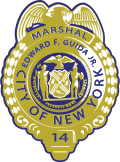
NYC Marshal Edward Guida #14
We’ve been serving New York City’s landlords, creditors, and judgment holders since 1988 — when East New York was at one of the lowest points in its history and the city’s enforcement infrastructure was still taking shape. Edward F. Guida Jr. was brought into the business in 2007 by his father, the late City Marshal Edward F. Guida Sr., who ran the office for 25 years before his passing in 2014. Edward Jr. managed the transition and was formally appointed Marshal, City of New York, Badge #14 in 2016.
What that history means for you is simple: our office manager and staff have worked here for years — they didn’t start fresh when the badge changed hands. We know the process, we know the courts, and we know how to guide clients through enforcement without creating unnecessary complications. For landlords in neighborhoods like New Lots or Cypress Hills who are navigating Brooklyn Housing Court for the first time, that institutional knowledge is exactly what you need in your corner.

Income Execution and Eviction Process, Brooklyn
The process starts when you contact us with your court documents — whether that’s a Warrant of Eviction issued by Kings County Housing Court, a judgment from NYC Civil Court, or a small claims decision you’ve been sitting on for 30 days or more. From there, we review what you have, advise you on the right enforcement approach for your specific situation, and get the execution docketed.
For eviction cases, once the warrant is in hand, we serve the required notices and schedule the execution. Brooklyn Housing Court has been processing a significant backlog of cases that were frozen during the pandemic moratorium — which means many East New York landlords are only now receiving warrants on situations that started years ago. We handle that reality without making it your problem to manage.
For money judgments — whether you’re pursuing wage garnishment through an income execution or a bank levy through a property execution — the approach depends on what’s known about the debtor’s employment and assets. New York law caps wage garnishment at 10% of gross wages per paycheck, and a bank levy can reach up to double the judgment balance. We walk you through which avenue makes the most sense before anything is filed, so you’re not spending upfront fees on an approach that won’t produce results. One important note: only a licensed NYC Marshal or the Sheriff can legally execute a warrant of eviction or formally serve certain executions in New York. This isn’t optional, and it’s not something you can handle on your own.

Ready to get started?
Judgment Enforcement Services, East New York, NY
We handle the full range of civil enforcement services authorized under New York law — income execution (wage garnishment), property execution (bank levy and seizure of personal property), landlord and tenant eviction services, small claims enforcement, supreme and civil court judgment collection, and parking violations operations.
For East New York specifically, the mix of housing types matters. Whether you’re a landlord with a unit in a two-family rowhouse in New Lots, a property owner dealing with a tenant in one of the neighborhood’s many rent-stabilized buildings, or a small business owner on Linden Boulevard who won a civil court judgment against a customer who never paid — the enforcement path is different for each situation, and we advise accordingly.
East New York also has a significant subsidized housing presence, with 776 properties carrying some form of subsidy as of 2025. Enforcement actions in and around subsidized buildings require precision — a misstep in procedure can create regulatory exposure for the landlord. We conduct all proceedings in a neutral, professional manner toward all parties, which isn’t just a legal obligation — it’s the approach that protects you from liability and keeps the process clean. All five boroughs are covered, so if a debtor has moved from East New York into Queens or the Bronx, enforcement doesn’t stop at the borough line.

What do I actually do after Brooklyn Housing Court issues a Warrant of Eviction?
Once Kings County Housing Court issues a Warrant of Eviction, the next step is legally required — you must engage a licensed NYC Marshal or the Sheriff to execute it. You cannot carry out the eviction yourself. Attempting a self-help eviction in New York exposes you to criminal liability, regardless of how clear-cut your case is.
To get the process started with us, you’ll need to provide your court documents, including the judgment and the warrant. We review what you have, confirm the correct procedure for your specific property and situation, and handle the service of notices and scheduling from there. For East New York landlords who have been waiting through Brooklyn Housing Court’s post-pandemic backlog, the priority is getting the execution moving as efficiently as possible once the warrant is finally in hand. We’re set up to do exactly that.
What is the difference between an income execution and a property execution in New York?
An income execution — also called wage garnishment — directs the debtor’s employer to withhold a portion of their wages and send it to us, and we then forward it to you. Under New York law, that amount is capped at 10% of the debtor’s gross wages per paycheck. It’s a steady, ongoing collection method that works well when the debtor has a stable job.
A property execution works differently. Instead of going after wages, it targets the debtor’s bank accounts or personal property. We can levy up to double the judgment balance from a debtor’s banking institution. Which approach makes more sense depends entirely on what’s known about the debtor — their employment status, where they bank, and what assets they have. In East New York, where median household incomes are lower and some debtors may be working part-time or in cash-based employment, we advise on the most viable path before you commit to either approach.
How much does it cost to hire a NYC Marshal for an eviction or judgment enforcement?
Marshal fees in New York are set by state statute — they’re not negotiable and don’t vary between marshal offices. For most enforcement actions, the upfront fees you pay to get started range from approximately $55 to $125, depending on whether you’re pursuing an income execution or a property execution and what service steps are required.
Beyond the upfront fees, we also earn a 5% poundage on any money actually collected. That structure matters: our larger income is directly tied to successfully recovering what you’re owed, not just processing paperwork. For East New York landlords and creditors who are watching their margins carefully, the low upfront cost and performance-based model make starting the enforcement process a reasonable step — especially when the alternative is a judgment sitting unpaid for years while interest accrues at 2% annually.
Can a NYC Marshal collect a small claims judgment in East New York, Brooklyn?
Yes. After the mandatory 30-day waiting period following your small claims judgment, you can engage us to enforce it. We’re authorized to enforce small claims judgments across all five boroughs, using either income execution or property execution depending on the debtor’s situation.
This is one of the more overlooked services we provide. A lot of small business owners along Linden Boulevard or Pennsylvania Avenue win their small claims case in Brooklyn Civil Court and then don’t know what happens next. The judgment doesn’t collect itself. If the debtor doesn’t pay voluntarily within 30 days, you have the right to pursue enforcement — and waiting longer only gives the debtor more time to move assets or change jobs. The process starts with a modest upfront fee, and we walk you through exactly what documents you’ll need to bring.
What happens if the debtor in East New York has no steady job or visible assets?
This is a real concern in a neighborhood where unemployment runs around 10% and many residents work in lower-wage or informal employment. But limited visible assets doesn’t mean enforcement is impossible — it means you need to think through which of the available enforcement avenues fits the debtor’s actual situation.
There are multiple tools available under New York law beyond wage garnishment. A property execution can target bank accounts, and we can levy up to double the judgment balance from a debtor’s banking institution. Personal property seizure is another avenue. We review what’s known about the debtor and advise on where to start. In some cases, the right move is to file the execution and wait — debtors’ circumstances change, and a properly filed execution preserves your right to collect when their situation improves. The 20-year lifespan of a New York judgment gives you time, and we help you use it strategically.
Does NYC Marshal Edward Guida #14 serve East New York and the surrounding Brooklyn neighborhoods?
Yes. We cover all five boroughs — Manhattan, Brooklyn, Queens, the Bronx, and Staten Island — so East New York and the surrounding areas of Cypress Hills, New Lots, Spring Creek, and Starrett City are all within our service area. The same goes for neighboring communities across the Queens border, including Woodhaven and Ozone Park, which is relevant for East New York landlords and creditors whose cases involve debtors who have relocated across the borough line.
We’re based in Corona, Queens — in the same eastern New York City corridor as East New York, connected by the Jackie Robinson Parkway and the subway network through Broadway Junction. That proximity means we have practical familiarity with this part of the city, not just theoretical coverage on a map. Whether your case is in Kings County Housing Court or involves enforcement across multiple boroughs, you won’t need to find a second marshal to finish what we start.
Contact Us Today
Call us at (718) 779-2134 or email us at guidajr@nycmarshal14.com to see how we can help.