Contact us today at (718) 779-2134 to see how we can help you!
NYC Marshal Services in East Flatbush, NY
East Flatbush Landlords Need More Than a Marshal Who Shows Up

Hear from Our Customers

Eviction Marshal Serving East Flatbush, Brooklyn
When you have a judgment or a warrant of eviction and the other party still isn’t moving, the frustration isn’t just financial — it’s the feeling that winning in court didn’t actually mean anything. That changes the moment a licensed NYC Marshal gets involved. Enforcement is no longer optional for the other side. It’s happening.
For landlords in East Flatbush specifically, that matters more than it does in most Brooklyn neighborhoods. The NYC Department of Health and Mental Hygiene rates evictions here as higher than most neighborhoods citywide — and with a housing stock dominated by multi-family brick buildings, two-family homes, and large rent-stabilized complexes like Flatbush Gardens, the volume of landlord-tenant disputes in this neighborhood is real and ongoing. One non-paying tenant in a six-unit building doesn’t just cost you one month’s rent. It compounds fast.
For creditors who won a judgment against someone working in East Flatbush, the enforcement picture here is actually more favorable than many people expect. The neighborhood’s largest employers — Kings County Hospital, SUNY Downstate Medical Center, and Kingsbrook Jewish Medical Center — are major institutional payrolls with HR departments that can process income execution orders. If your debtor works in healthcare here, wage garnishment is a viable, practical path to collecting what you’re owed. We know how to move on that quickly.
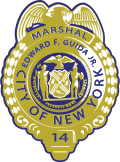
NYC Marshal Badge #14 Serving Kings County
I was appointed by the Mayor of New York City and have been serving creditors, landlords, and judgment holders across all five boroughs since my formal appointment in 2016 — but our office itself has been operating since 1988 under my father, the late City Marshal Edward F. Guida Sr. That’s not a marketing angle. It’s just the history.
The office manager and staff who work here today worked under my father for years before the transition. So when you call about an eviction in East Flatbush or a wage garnishment tied to a Kings County judgment, you’re not talking to someone who’s figuring it out as they go. You’re talking to a team that has seen virtually every enforcement scenario this borough produces — including the kind of organized tenant opposition that’s become common in neighborhoods like East Flatbush.
I’m backed by a $100,000 public officer’s bond, regulated by the NYC Department of Investigation, and I’m one of only 28 currently active NYC Marshals out of a possible 83 appointments. That scarcity reflects how seriously the city takes who gets this authority.

How Income Execution Works in East Flatbush
Most people who call our office are doing it for the first time. You won your case, you have a judgment or a warrant, and now you’re not sure what the next step looks like. Here’s how it works.
You provide the relevant documents — your judgment, the execution, or the warrant of eviction issued by the NYC Housing Court — along with a modest upfront fee set by state statute. That fee covers us receiving and recording your case, and serving the appropriate notice on the debtor or tenant. For income executions, the debtor is served first, and if they don’t begin making payments voluntarily within 20 days, we then serve the employer directly. For property executions, we can move on bank accounts or personal property. For evictions, once we have the warrant and the required 72-hour notice has been served, we execute the removal.
One thing worth knowing if you’re pursuing an eviction in East Flatbush: a significant portion of the rental housing here is rent-stabilized, which means tenants have additional legal protections and tenant organizations like the Flatbush Tenant Coalition are experienced at challenging evictions that have procedural gaps. We conduct every enforcement action in a neutral, professional manner — not just because that’s the right way to operate, but because in this neighborhood, doing it correctly is what makes it stick. The NYC Department of Investigation oversees all our activity, and that accountability runs through every step of the process.

Ready to get started?
Judgment Enforcement and Eviction Services Brooklyn
We handle the full range of civil enforcement services across Kings County and all five boroughs. That includes income execution — also known as wage garnishment — where we work directly with the debtor’s employer to secure deductions from each paycheck. Given that healthcare is the dominant employment sector in East Flatbush, with three major hospital systems operating in the neighborhood, income execution is often one of the most effective tools available here. Large institutional employers have the payroll infrastructure to comply, and we know how to move efficiently through that process.
Property execution covers bank levies and seizure of personal property or cash to satisfy a judgment. We can levy up to double the judgment balance from a debtor’s banking institution — a detail that matters when the debtor has assets but isn’t paying voluntarily. Small claims judgments from NYC Civil Court can be enforced starting 30 days after the judgment date, using either income or property execution. Supreme Court and Civil Court judgments are handled the same way, with us advising on which enforcement avenue fits the debtor’s specific situation.
For landlords, we’re authorized to perform both legal possession and full eviction once a warrant of eviction has been issued by the NYC Housing Court — covering every building type in East Flatbush, from the two-family homes along Remsen Avenue to the larger multi-unit complexes throughout the neighborhood. Upfront fees are set by state statute, typically in the range of $55 to $125 depending on the type of execution. We earn poundage — 5% of amounts actually collected — only when money is recovered, which means our incentive to collect runs in the same direction as yours.

Do I need a NYC Marshal to carry out an eviction in East Flatbush?
Yes — and this is one of the most common points of confusion for landlords who are going through this process for the first time. Once the NYC Housing Court issues a warrant of eviction, you cannot remove the tenant yourself. Attempting to do so — changing the locks, removing belongings, shutting off utilities — is considered an illegal self-help eviction under New York law, and it exposes you to serious legal liability regardless of how clear-cut your case is.
Only a licensed NYC Marshal or the Sheriff’s Office can legally execute a warrant of eviction. In practice, we handle the overwhelming majority of residential evictions in New York City — the Sheriff’s Office executed only 36 residential evictions in the first five months of 2024, compared to thousands carried out by marshals. In East Flatbush specifically, where tenant legal organizations like the Flatbush Tenant Coalition and Brooklyn Legal Services’ Tenant Rights Coalition are active and experienced, the importance of working with a marshal who follows procedure precisely cannot be overstated. A procedural error gives a tenant grounds to challenge the eviction in court, which resets the clock entirely.
How long does the eviction process typically take once I have a warrant?
Once you have a warrant of eviction from the NYC Housing Court, we’re required to serve a 72-hour notice on the tenant before executing the removal. That notice period is mandatory regardless of how long the non-payment situation has been going on. After the 72-hour notice is served, we schedule the eviction — and the tenant has that window to either vacate voluntarily or be removed on the scheduled date.
The total timeline from the moment you engage us to the day of execution depends on a few factors: how quickly your documents are submitted, court scheduling, and whether there are any weather-related suspensions. The NYC Department of Investigation does issue eviction suspension notices during certain weather or air quality events, which can briefly delay scheduling. In East Flatbush, where a significant portion of the neighborhood’s rental housing is rent-stabilized, there may be additional procedural steps tied to the tenant’s stabilized status — another reason to work with a marshal who knows how those cases are handled.
What is an income execution and how does wage garnishment work in New York?
An income execution — commonly called wage garnishment — is a legal order that directs a debtor’s employer to withhold a portion of each paycheck and send it to us, and we then pass it along to you as the judgment creditor. In New York, the garnishment amount is capped at 10% of the debtor’s gross wages per paycheck, so it’s not a lump-sum collection — it comes in over time with each pay cycle.
Here’s how the process works: we first serve the income execution on the debtor directly. The debtor then has 20 days to either begin making voluntary installment payments or face service on their employer. If they don’t act within that window, we serve the employer, and deductions begin from the next paycheck. For creditors in East Flatbush or holding judgments against debtors who work there, this is often a reliable enforcement path. The neighborhood’s three major hospital employers — Kings County Hospital, SUNY Downstate Medical Center, and Kingsbrook Jewish Medical Center — are large institutional payrolls that have the administrative infrastructure to process garnishment orders correctly and consistently.
What is a property execution, and can a marshal levy a bank account?
A property execution authorizes us to seize cash or personal property belonging to the debtor — including funds held in a bank account — to satisfy a judgment. When the target is a bank account, we serve the execution on the bank directly, and the bank is required to freeze and turn over funds up to the amount specified. Importantly, we can levy up to double the judgment balance from a debtor’s banking institution, which provides some buffer if the account balance fluctuates.
Not all property is reachable. Certain exemptions apply under New York law — for example, a debtor’s primary residence (real property) cannot be seized through a property execution, and some categories of personal property are protected. But bank accounts, cash on hand, and non-exempt personal property are all fair game once you have a civil judgment and a properly issued execution. If you’re not sure whether income execution or property execution is the better approach for your specific debtor, that’s exactly the kind of question our office can help you think through based on what you know about the debtor’s employment and financial situation.
I won a small claims judgment in Brooklyn — can a marshal collect it for me in East Flatbush?
Yes. We’re authorized to enforce small claims judgments across all five boroughs, including Kings County. Small claims judgments can be enforced by either income execution or property execution, and the process becomes available 30 days after the date the judgment was entered — so you don’t have to wait indefinitely for the debtor to pay voluntarily.
Small claims court in Brooklyn handles disputes up to a certain dollar threshold, and a significant number of cases come from East Flatbush’s commercial corridors — Utica Avenue, Nostrand Avenue, Church Avenue — where small business disputes over unpaid invoices, service contracts, or deposits are common. If you’re a business owner or individual who won a judgment and the other party simply hasn’t paid, we can serve an income execution on their employer or a property execution on their bank account. The upfront fees are set by statute and are modest — typically in the $55 to $125 range depending on the type of execution — and we earn the bulk of the fee only when money is actually collected.
What's the difference between a NYC Marshal and a collection agency for enforcing a judgment?
They’re fundamentally different tools, and only one of them can actually compel payment through legal force. A collection agency contacts debtors and attempts to negotiate or pressure payment — but they have no legal authority to garnish wages, levy bank accounts, or execute a warrant of eviction. If the debtor ignores them, the agency has no enforcement mechanism beyond reporting to credit bureaus or referring the account to an attorney.
A NYC Marshal is a government-appointed public official with the legal authority to execute court orders. Once you have a judgment from the NYC Civil Court, Supreme Court, or small claims court, we can serve a formal income execution on the debtor’s employer or a property execution on their bank — and those institutions are legally required to comply. The debtor doesn’t get to decide whether to participate. That’s the difference. For creditors in East Flatbush who have already gone through the court process and have a judgment in hand, a collection agency at that stage is largely redundant. We are the enforcement step — the one with actual legal teeth. And unlike a collection agency’s fee structure, our poundage (5% of what’s collected) is set by state statute, so there are no surprise charges or negotiated percentages eating into your recovery.
Contact Us Today
Call us at (718) 779-2134 or email us at guidajr@nycmarshal14.com to see how we can help.