Contact us today at (718) 779-2134 to see how we can help you!
NYC Marshal Services in Borough Park
When Brooklyn Housing Court Issues Your Warrant, Borough Park Landlords Need a Licensed Marshal

Hear from Our Customers

Judgment Enforcement for Borough Park Landlords
Borough Park carries one of the steepest rent burden gaps in all of Brooklyn. According to the NYU Furman Center, 36% of renters here spend more than half their income on rent, and rent growth has outpaced income growth by over 22 percentage points. For a landlord managing a two-family home on a numbered street between 13th and 16th Avenues, a tenant who stops paying isn’t a minor inconvenience — it’s a financial emergency. The mortgage doesn’t pause. The property tax bill doesn’t wait. And the court process that got you here already took months.
Once you have a warrant of eviction or a civil court judgment in hand, enforcement is where things either move forward or stall out. A licensed NYC Marshal is the only legal path to executing that warrant. That means the marshal’s speed, professionalism, and judgment about how to handle the situation all matter — especially in a neighborhood as tight-knit as Borough Park, where how something is done reflects on you as much as whether it gets done.
We’ve been handling the enforcement side of these cases since 1988. Not a collection agency. Not an attorney sending demand letters. A government-appointed marshal with the authority, the tools, and the institutional knowledge to actually execute what the court has ordered.
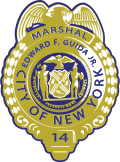
NYC Marshal Badge #14, Brooklyn — Family-Run Since 1988
Edward F. Guida Jr. holds Badge #14, appointed by the Mayor of New York City and overseen by the NYC Department of Investigation. We didn’t start from scratch in 2016 when the current appointment began — we trained under Edward Sr., who built this office from the ground up in 1988 and served New York City’s five boroughs for 25 years. The office manager and staff who work here today worked under Edward Sr. as well. That kind of continuity is rare anywhere, and it matters when you’re navigating something as consequential as a Kings County eviction or a civil court judgment enforcement.
Borough Park landlords and business owners on 13th Avenue understand what it means to have a community reputation on the line. We conduct every enforcement action in a professional, respectful manner — toward all parties involved — because that’s the only way to do this work right in a neighborhood where people know each other and where word travels.

Eviction and Judgment Enforcement Process in Borough Park
Once Brooklyn Housing Court issues a warrant of eviction, or a civil or small claims court enters a judgment in your favor, the clock starts. After 30 days from a small claims judgment — or immediately upon entry for civil and supreme court judgments — you can move forward with enforcement. You bring the paperwork to us, pay the required statutory upfront fees, and we get to work.
For evictions, we begin with a Notice of Eviction served on the tenant, followed by scheduling the actual eviction on the first legal date available. We coordinate with the NYPD 66th Precinct when a police presence is needed, which is standard procedure for Borough Park evictions. If you’re enforcing a money judgment rather than removing a tenant, we’ll advise you on whether income execution — serving the debtor’s employer to garnish wages — or property execution — levying a bank account or seizing personal property — is the more effective route given your debtor’s specific situation.
This distinction matters in Borough Park. A significant portion of the neighborhood’s workforce is self-employed, works for religious institutions, or earns income through arrangements that don’t run through a standard payroll. In those cases, a bank levy through property execution is often the right tool, not a wage garnishment. That’s the kind of case-specific guidance we provide — not a one-size-fits-all approach.
One timing factor worth knowing: New York law suspends evictions during severe weather events and snow emergencies, which can push scheduled dates in winter months. If you’re planning enforcement in the December through February window, build in some flexibility. We stay current with all NYC Department of Investigation weather suspension notices and will keep you informed.

Ready to get started?
Judgment Enforcement Services in Borough Park, NY
We handle the full range of civil enforcement services available under New York law, all of which apply directly to Borough Park residents, landlords, and business owners operating in Kings County.
For landlords, that means executing warrants of eviction issued by Brooklyn Housing Court — including both full eviction and legal possession, depending on what the court has authorized and what you need. For creditors with money judgments, we handle income execution (wage garnishment, capped at 10% of the debtor’s gross wages per paycheck under New York law) and property execution (bank account levy, which can reach up to double the judgment balance, as well as seizure of personal property). Small claims judgments from Brooklyn’s small claims court are fully enforceable through the same mechanisms, and we cover all five boroughs — so if your debtor or tenant has relocated from Borough Park to another neighborhood or another borough entirely, enforcement doesn’t stop.
For the independent business owners on 13th Avenue or 16th Avenue who won a judgment and have no attorney guiding them through what comes next, we can walk you through exactly what documents you need and what to expect at each step. The upfront statutory fees to begin enforcement are modest — our significant income comes from poundage collected when money is actually recovered, which means our incentive is aligned directly with yours.

After Brooklyn Housing Court issues a warrant, what happens next in Borough Park?
Once Brooklyn Housing Court issues a warrant of eviction, you need to hire a licensed NYC Marshal to execute it. That’s not optional — New York law requires that only a NYC Marshal or the Sheriff can legally carry out a warrant of eviction. You cannot remove a tenant yourself, change the locks without going through this process, or take any self-help action. Doing so exposes you to serious legal liability, including criminal charges.
After you bring the warrant to us and pay the required upfront statutory fees, we serve a Notice of Eviction on the tenant. The eviction itself is then scheduled for the first legally available date. In Borough Park, the 66th Precinct is the coordinating police precinct for evictions that require a law enforcement presence, which is standard. The whole process moves faster when your paperwork is complete and accurate from the start, so we’ll tell you exactly what you need before you come in.
What is the difference between income execution and property execution in New York?
Income execution is wage garnishment — we serve the debtor’s employer, and a portion of each paycheck (up to 10% of gross wages under New York law) is redirected to satisfy the judgment. Property execution targets assets directly: most commonly a bank account, where we can levy up to double the outstanding judgment balance, or personal property that can be seized and sold.
Which one is right for your situation depends on the debtor. In Borough Park specifically, a meaningful portion of residents are self-employed, work for yeshivas or religious institutions, or earn income through informal arrangements that don’t run through a standard payroll. In those cases, income execution may not be the effective tool — there’s no employer to serve. Property execution, particularly a bank levy, becomes the primary path. We’ll review the specifics of your debtor’s situation and advise on which approach gives you the best chance of actually recovering what you’re owed.
Can I enforce a small claims court judgment through a NYC Marshal?
Yes. If you won a judgment in small claims court — whether in Brooklyn or any of the five boroughs — we can enforce it through income execution or property execution. You need to wait 30 days from the date of the judgment before enforcement can begin, which gives the losing party a window to pay voluntarily. After that window closes, you don’t have to wait any longer.
For Borough Park business owners on 13th Avenue or 16th Avenue who handled their small claims case without an attorney, the process of hiring a marshal can feel unfamiliar. It’s more straightforward than it sounds. You bring the judgment paperwork, pay the statutory upfront fees, and we handle the enforcement from there. We cover all five NYC boroughs, so even if the person who owes you money has moved out of Borough Park, enforcement doesn’t stop at the Kings County line.
How much does it cost to hire a NYC Marshal in Borough Park?
Marshal fees in New York are set by statute — they’re not negotiable and don’t vary from one marshal office to another. The upfront fees to begin enforcement typically run in the range of $55 to $125 depending on the type of execution you’re pursuing. Income execution and property execution each have their own fee structure under state law, and we’ll tell you exactly what applies to your case before you commit to anything.
Beyond the upfront fees, we earn poundage — 5% of the amount actually collected. That’s the structure that matters most, because it means our financial incentive is directly tied to whether you recover money. If nothing is collected, we don’t earn poundage. For Borough Park creditors who have already spent time and money winning their court case, that alignment of incentives is meaningful. You’re not paying a flat retainer regardless of outcome — the enforcement side of the fee scales with results.
What if the person who owes me money has no employer — can a marshal still help?
Yes, and this comes up frequently in Borough Park. The neighborhood has a substantial self-employed population, a large number of residents working for religious institutions on stipend-based arrangements, and a well-documented informal economy. When a debtor doesn’t have a traditional employer, income execution — wage garnishment — isn’t the right tool because there’s no payroll to attach to.
In those cases, property execution is the primary avenue. A bank levy allows us to reach the debtor’s bank account directly, up to double the outstanding judgment balance. Personal property can also be seized and applied toward the debt. There are multiple enforcement avenues available under New York law, and we assess which combination makes sense for the specific debtor’s situation. We’ve been navigating exactly these kinds of cases across all five boroughs for years — this isn’t a scenario we haven’t seen before.
Does the Jewish holiday calendar affect eviction scheduling in Borough Park?
It’s a practical question, and it’s worth thinking through if you’re a Borough Park landlord scheduling an eviction. Evictions in New York are already subject to suspension during severe weather events and snow emergencies under NYC Department of Investigation protocols — that’s a standard citywide rule that applies regardless of neighborhood. But in Borough Park specifically, the Orthodox Jewish community observes a dense calendar of major holidays throughout the year, including Rosh Hashanah, Yom Kippur, Sukkot, Passover, and Shavuot, in addition to Shabbat every week.
New York law does not automatically suspend evictions on Jewish holidays the way it does for declared weather emergencies. However, if you’re a landlord who lives and operates within the Borough Park community, scheduling an eviction on a major holiday can create complications — practically and socially. When you work with us, you can discuss scheduling considerations upfront. We’re familiar with the Borough Park community and can help you think through timing so the process moves forward without unnecessary friction. The goal is always to handle enforcement professionally and with as little disruption as possible for everyone involved.
Contact Us Today
Call us at (718) 779-2134 or email us at guidajr@nycmarshal14.com to see how we can help.